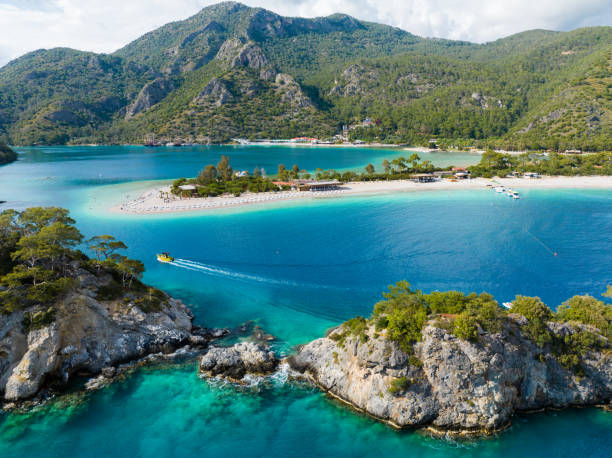
Turkey's south-western shores form a transition zone where the cool waters of the Aegean melt into the mild climate of the Mediterranean. In this landscape, where pine-covered slopes drop steeply to the sea, millennia-old settlements, monumental rock-cut tombs, ancient trade routes and quiet fishing towns intertwine. Fethiye stands out not only as a summer seaside destination: with maquis that turns green in spring, mild autumn weather and walking routes open all year round, it is a region to visit in every season. Muğla is the province with both the longest coastline and the densest historical heritage on this stretch of coast.
Fethiye, in Muğla, is the most visited district of this rich geography. Built over ancient Telmessos, the town centre is on one side a lively coastal town with its marina, bazaar and seafront, and on the other an open-air museum of rock tombs. Within the district you will find remarkably different stops, from a world-famous lagoon to a walking route of more than 500 kilometres, from an abandoned stone village to a deep canyon. Below you will find the highlights among the places to visit in Fethiye — what each one offers, in which season it is most enjoyable, and what to bear in mind when visiting.
Kayaköy
About 8 kilometres from the centre of Fethiye, Kayaköy — formerly known as Levissi — is one of the region's most striking stops. Inhabited by a Greek population until the 1923 Turkish-Greek population exchange, the village emptied afterwards and has become a silent hillside scene of roughly five hundred houses whose stone walls still stand. Walking the narrow paths between the roofless houses you can still make out doorsteps, hearths and cisterns. Of the village's two large churches, the floor mosaics and wall traces of the Upper Church are the most photographed spots. As the site is protected as a cultural asset, entrance is charged and it is open during set hours. Since the midday heat can be stifling on the slope in summer, early morning or late afternoon is the better choice. The stone-paved historic path from Kayaköy to Ölüdeniz offers a pleasant walk of about two hours.
Ölüdeniz
Ölüdeniz is the first place that comes to mind at the mention of Fethiye, and it fully deserves its fame. Separated from the open sea by a thin tongue of sand, the lagoon is sheltered from the wind and barely ripples; the view of the water shifting from turquoise to deep blue has become the region's emblem. As the lagoon lies within a nature park, entrance is charged, whereas the Ölüdeniz beach on the Belcekız and Kumburnu side is free to use. Overlooking the area, Babadağ is one of the world's foremost paragliding take-off points; flights from the launch sites at 1,700 and 1,965 metres last about 30-40 minutes and land directly on the beach. In the evening, the lively Ölüdeniz bazaar area lines up cafés, ice-cream shops and souvenir stores. The swimming season generally runs from late May to mid-October.
The Lycian Way
The Lycian Way is a long-distance walking route of more than 500 kilometres, starting at Ovacık near Fethiye and stretching to Hisarçandır near Antalya. The route follows the paths, shepherd tracks and Roman-era stone pavements that once linked the cities of the ancient Lycian League. Marked with red-and-white paint, the trail takes more than a month to walk end to end, so it is usually explored in stages. The first stages out of Fethiye follow the Ovacık, Kozağaç, Faralya and Kabak line; this section, where the sea view never leaves the path, is the most popular part of the route. Spring and autumn are the best walking seasons; in July and August the heat and lack of shade are a serious challenge. Before setting out, carry enough water, keep an up-to-date map and plan your overnight stops in advance.
Kabak Bay
Hidden at the foot of a steep slope south of Faralya, Kabak Bay is a haunt of those who want to escape the crowds. The bay is reached by a steep path of about half an hour starting from the viewpoint above, or by the shuttles run by local businesses. Below lies a beach of mixed pebbles and coarse sand, backed by bungalow-style accommodation shaded by laurel and pine. The limited electricity and communications infrastructure is one of the factors preserving the bay's calm character. As Kabak lies on the Lycian Way, it has a mixed atmosphere of hikers and holidaymakers. It is also possible to cross to neighbouring Butterfly Valley by boat. Bear in mind that driving down to the bay is difficult, as the road is narrow and full of bends.
Paspatur Bazaar
The historic places to see in Fethiye are not limited to ancient ruins; the town's old bazaar, Paspatur, is on the list too. A web of narrow cobbled lanes, the bazaar is a quiet shopping area in the morning and the town's liveliest quarter in the evening. Meyhanes, fish restaurants, coffee houses and craft shops follow one another; the vines and lanterns strung across the alleys give the area a texture of its own. At the fish market right next to the bazaar you can buy the fish you like and have it cooked at the surrounding eateries — one of Fethiye's best-known dining traditions. Topping the list of places to visit in Fethiye in the evening, Paspatur is walkable in scale and very convenient for those staying in the centre.
Tlos Ancient City
Located near the village of Yaka to the north-east of Fethiye, Tlos is one of the six oldest and most important cities of Lycia. The settlement's history reaches back to the 2nd millennium BC; under the name recorded in Hittite sources, it is one of the region's deep-rooted centres. The city's acropolis rises on a rocky hill later crowned by an Ottoman-era fortress, commanding a sweeping view over the Eşen Plain. Among the rock-cut tombs, the most admired is the one known for its relief of Bellerophon riding the winged horse Pegasus. The site also lets you explore a stadium, bath complexes, a theatre and the remains of the agora. Tlos neighbours the Yaka area, known for its trout farms and plane-tree shade; combining the ancient city visit with a break at these establishments is a popular choice.
The Rock Tombs of Fethiye
The Lycian rock tombs carved into the cliffs right above the town centre are Fethiye's best-known symbol. The most magnificent among them is the Tomb of Amyntas, dated to the 4th century BC. Its façade is designed to look like a temple with two columns and a triangular pediment; the imitation wooden door carved into the stone is still clearly visible today. Reaching the tomb requires climbing a stairway of about two hundred steps. At the top you are met by a view of Fethiye taking in the bay, the islands and the harbour at once; this spot, where the sunset changes the colour of the stone, is a favourite of photographers. The site is ticketed and, being within walking distance of the centre, fits easily into an itinerary.
Çalış Beach
About 5 kilometres from the centre of Fethiye, Çalış is the district's longest shore. Stretching for roughly four kilometres, the pebbly beach is busy all day with its promenade and rows of cafés behind it. The area is best known for its sunset; thanks to its west-facing position, the sun sinks behind the islands opposite, offering a long spectacle along the shore. The wind that picks up in the afternoon makes Çalış well suited to windsurfing and kitesurfing. Water taxis from the beach take you to Fethiye Harbour in about fifteen minutes. The wetland behind the beach is known as the Fethiye Bird Sanctuary and hosts many species, including flamingos, during migration seasons.
The Dalyan Rock Tombs
About an hour and a half from Fethiye, Dalyan is a fixture of regional tours even though it lies outside the district. Carved into the sheer cliffs on the far bank of the Dalyan River, the Kaunos rock tombs date to the 4th century BC and, with their temple façades, show the Lycian tradition reflected in Carian lands. The tombs are best seen from the river, passing by boat. The same boat tours usually follow a route taking in the ancient city of Kaunos, the mud baths, thermal pools and İztuzu Beach, famous for its loggerhead turtles. As a nesting ground for sea turtles, İztuzu is closed at night and practices such as driving stakes into the beach are prohibited. Dalyan is one of the most balanced options among the holiday spots around Fethiye, combining nature and history.
Ferry Crossing from Fethiye to Rhodes
While exploring Fethiye you can add an extra day to your programme and cross to Rhodes, the largest island of Greece's Dodecanese. The crossings from Fethiye Harbour to Rhodes, operated with the assurance of Tilos Travel, use high-speed catamaran-type ferries and reach the opposite shore in just 1 hour 30 minutes. As the 350-passenger ferry runs all year round, the route can be used outside the summer season as well. Taking the morning departure and returning the same day, it is possible to see Rhodes' medieval walled town, the Street of the Knights and Lindos in a single day; those who prefer a more relaxed programme stay one night on the island. As this is an international route, a passport is required, and you should allow enough time at the port before departure for entry and exit formalities.
| Crossing Time | 1 hour 30 minutes |
|---|---|
| Ferry Type | High-speed catamaran |
| Capacity | 350 passengers |
| Season | All year round |
Turkish citizens can cross to Rhodes with a door visa (visa on arrival); see our door visa page for the required documents and the application process.
Things to Do in Fethiye
Beyond swimming, the district offers a wide range of activities. Daily boat tours follow the 12 Islands route, stopping at spots such as the Yassıca Islands, Tersane Island and Aquarium Bay. Paragliding from Babadağ, scuba-diving trips run by dive schools, the rafting courses around Saklıkent and the cycling routes in the Kadıköy area rank among the top things to do in Fethiye. For a cultural programme, the Fethiye Museum and the UNESCO-listed ancient cities of Letoon and Xanthos are within a day trip's reach. In the evenings, the meyhanes of Paspatur, the seafront cafés towards Karagözler and the sunset cruises on boats in the harbour are the favourites. In short, whether you want to rest or to keep exploring without pause, Fethiye is one of those rare holiday regions that makes room for both at once.
Fethiye is a district that cannot be confined to a single type of trip: in the morning you may be on the steps of an ancient city, in the afternoon on the shore of a lagoon, and in the evening in a bazaar of stone-paved streets. That is why the most efficient method is to choose the centre as your base and plan day trips around it. Considered together with its Rhodes connection, Fethiye is not merely a holiday stop but a gateway opening onto the islands between the Aegean and the Mediterranean.
You May Also Like → A Comprehensive Guide to Rhodes Island